
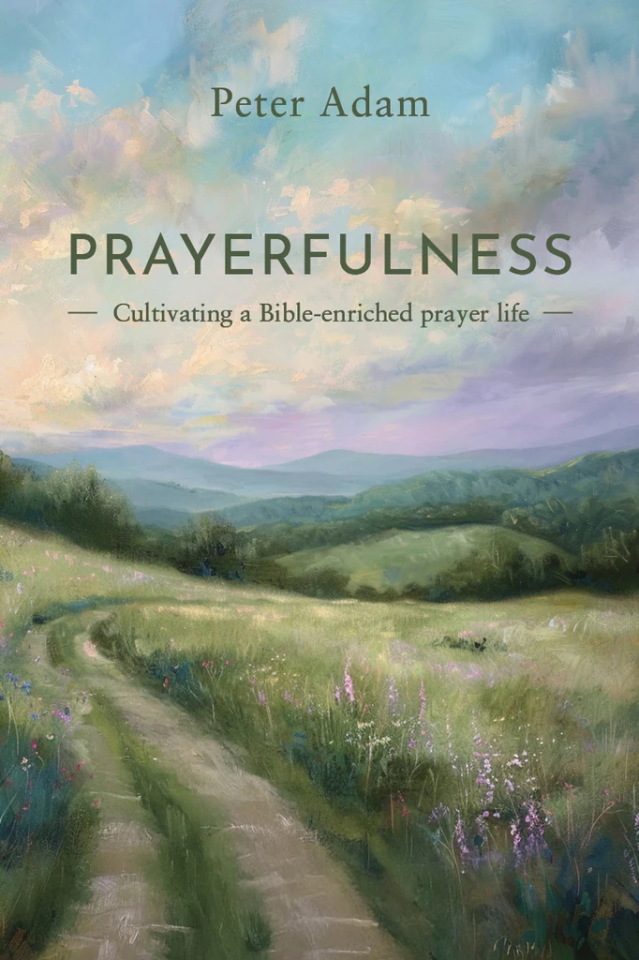
It does us a lot of good to read a book on prayer every couple of years, because the Christian life is a praying life, and Christians need the occasional reminder and encouragement to keep praying or to start praying again after an overly busy or overly anxious period of life.
Enter Prayerfulness, a recent book by Peter Adam that, according to CCL Director Tony Payne, is the best book on prayer and the Christian life he’s ever read. It’s warm and full of pastoral wisdom, theological richness, and many practical helps and resources.
On this episode of the CCL Podcast, Peter Adam speaks about prayerfulness, how prayer is an expression of our relationship with God, why written prayers are helpful, and why we don’t pray.
Links referred to:
- Prayerfulness (Peter Adam)
- Find out more and register for the Priscilla & Aquila Centre 2026 annual conference
- Support the work of the Centre.

Runtime: 40:36 min.
Transcript
Please note: This transcript has been checked against the audio and lightly edited, but still may contain errors. If quoting, please compare with the original audio.
Introduction
[00:00:05] Tony Payne: It does us a lot of good to read a book on prayer every couple of years, I think, because the Christian life, if it’s anything, is a praying life. And if your praying life is anything like mine, you do need the occasional reminder and encouragement to keep praying or to start praying again after an overly busy or overly anxious period of life.
[00:00:26] And I have the book for you: it’s by Peter Adam. It’s simply called Prayerfulness. And perhaps I’m suffering from recency bias, but it’s the best book on prayer and the Christian life that I can remember reading—in its warmth and pastoral wisdom, in its theological richness, and in its many practical helps and resources.
[00:00:47] And on today’s episode of the Centre for Christian Living Podcast, we’re talking with the author, Peter Adam, about prayerfulness.
[Music]
[00:01:09] Tony Payne: Well, hello again. Welcome to another episode of the Centre for Christian Living Podcast. I’m Tony Payne, and it’s great to be with you again. And today, we’re talking to Peter Adam. Peter’s name is one that many of you will know—as a long-time Bible speaker and preacher and author, long-time rector of St Jude’s Church in Carlton in Melbourne, and the former Principal of Ridley College in Melbourne.
[00:01:32] And among Peter’s many gifts is the gift of helping others learn to pray. He’s been running workshops on the nature of prayer at various points for many years, and the fruit of all that thinking is a book called Prayerfulness: Cultivating a Bible-enriched prayer life. And in today’s episode, I wanted to talk to Peter about his book and about the rich challenge and resource that it is for our prayerfulness. Peter, thanks for joining us today.
[00:01:58] Peter Adam: That’s a great pleasure and a privilege. Thank you.
The what and why of prayer
[00:02:00] Tony Payne: Can I kick things off by just asking, what do you mean by prayer? What is prayer and why is it important?
[00:02:06] Peter Adam: Well, in the Bible, God speaks to us, and in prayer, we reply and speak to God. It’s part of the communication between God and ourselves. God is a speaking God and a listening God. And we are listening people: if we read the Scriptures, we’re listening to God. And we should be speaking people, and the person we should speak to most of all is God.
[00:02:33] Tony Payne: One of the things I appreciated about the book was the variety and richness, multifaceted nature of that speaking to God that you explore at different points, because our speaking to God, I often think—I think most of us mainly think of intercession, of asking God for things. But it’s really struck me that the way you looked at prayer as a general category word that describes all this speaking to God that we might do, that it’s a rich thing. It’s not just asking for things; it’s also doing things like lamenting, for example.
[00:03:03] Peter Adam: Hmm. Yes. I mean the word prayer—”to pray”—is actually to, strictly speaking, is “to ask”. But I couldn’t think of another word which described the variety of verbal communications we have with God. And I’m so aware that, in human life, we can restrict ourselves to transactional conversations. “Would you please do this?” “Would you please do this?” “I’ve done this for you.” And often we can read the Bible in that way: we’re looking for things to do. Whereas the Bible is much bigger than a list of things to do; it’s God’s self-revelation of himself to us. And if God in all his glory and majesty and power and grace and kindness and love and constancy reveals himself, then there are bigger questions to ponder than “What can I ask?” And we should respond to who God is.
[00:03:54] I often say the life of a married couple, where there are four children and a budgerigar and so on, and a rabbit, can degenerate to task conversations: “You take the rabbit to the vet; I’ll take Gerald to ballet and Geraldine to hockey. And then if you put the rubbish out, I’ll do this, and so on.” But those transactional conversations—task conversations—are of a very thin means of communication.
[00:04:23] And so it is with God: God doesn’t just tell us to do things; he reveals who he is. And if God says, “I am the Lord your God, who brought you out of the land of Egypt,” then we should have a bigger response—a broader response—than, “Oh, would you mind converting my friend George?” So the breadth of God’s communication and Scripture should be matched by the breadth of our response to God—our verbal response to God—and then, of course, the lives we lead.
Praying for oneself
[00:04:54] Tony Payne: One of the aspects of your book in which that came out strikingly to me as I read it just recently was that as you model different prayers in the book, as you’ve written quite a few prayers and you give those prayers as example prayers to pray, it really struck me how not only there was a breadth of kind of talk with God—thanks and praise and self-dedication and self-offering through confession and lament and repentance, as well as asking God, interceding for all manner of things—many of your prayers, how can I put this? You pray for yourself much more than I pray for myself. This really struck me in your prayers for yourself. It’s an emphasis that I found challenging and very helpful.
[00:05:39] Tony Payne: Many of your prayers go into some depth and length of what you would like God to do in your life and how you are personally responding to God. And it challenged me, Peter, because I think I move very quickly from praying about my life and my sin and my offering to God onto the things that I want to ask him for other people.
[00:05:58] Peter Adam: Yeah, yeah. Well, what you have in my prayers for myself is so often when I read the Bible or when I’m preparing a Bible study or a sermon, I’m personally challenged by the Scriptures and I think, “Well, I should pray about that!” So I just add it to my daily prayers, which is why they get longer and longer. So they began as, I think, ten points of things I should pray for—for myself every day, and it’s got out of control now. So, for example, I remember I was actually preaching in Sydney at St Thomas’s North Sydney, and the Bible passage was “Set your hope on the grace to be given us when Jesus Christ is revealed.” And I thought, “I’ve never done that. I’ve always set my hope firmly on Jesus’ death and resurrection. So I better start praying that, and if I’m serious about it, pray it every day.” So then I included that in my daily prayers and I’m still praying it. And I keep on finding more things I need to pray every day.
Responding to God in prayer
[00:06:58] Tony Payne: What you just said touches on another theme that comes out often in the book, which is that prayer is a response to God. God speaks, we listen. We speak and God loves to listen to us. But that our prayers, our speaking to God, is shaped by his revelation of himself—by his word to us.
[00:07:16] Peter Adam: Yes, that’s right.
[00:07:17] Tony Payne: Can you speak a little bit about how, in your own life, and in how you try to teach people to pray, you’ve placed the Bible and what God says in the heart of prayer and how it shapes prayer?
[00:07:28] Peter Adam: Yes, yes. Calvin comments somewhere that when God speaks to us, he gives us words to pray. And the best thing to do is pray God’s words back to him, because obviously they’re important, because they’re the words he said to us.
[00:07:42] In the same way in which parents teach their children to speak, so God our Heavenly Father teaches us to speak by speaking to us. And of course, one of the wonderful features of the Bible is that it contains not only God’s direct words to us—”Be holy as I am holy”—but it also includes, in God’s kindness, God’s people’s words back to him—as, for example, in the Psalms and in Paul’s prayers and in many other prayers recorded in the Scriptures.
[00:08:13] And when you look at a prayer that—the prayer that Jonah prays, for example, and—or the prayer that Nehemiah prays in Nehemiah 1 or Daniel prays in Daniel 9, they’re saturated with Scripture. What they’re doing is quoting God’s words back to him saying, “This is who you are. This is what you promised to do. Please do it.” And that seems obvious in a way that God will not only teach us how to live in the Scriptures, but also how to pray—that is, how to respond to him with our words as well as our lives.
[00:08:47] Tony Payne: You quote from Saint Augustine in the book on this topic: you say, quoting him, “If the Psalm prays, you pray. If the Psalm laments, you lament. If the Psalm exalts, you rejoice. If it hopes, you hope. If it fears, you fear. Everything written here is a mirror for us.” And one of the many really helpful sections of the book is that section that I was quoted from, in which you take a whole series of the Psalms and excerpts from the Psalms, and give examples of the Psalms expressing trust, the Psalms expressing rejoicing or love and desire of God, or praise and worship of God, and suggest that we can take these words in our own lips to enrich our prayers.
[00:09:28] Peter Adam: Yes, that’s right. And I think one reason to do that is that the more we pray those prayers, the more we know what it feels like to pray them. We’re kind of trained to mouth the words—to feel the words in our mouths. So we do trust God. But I find it so wonderful to say to God, “I trust you.” And we do love God; I find it so wonderful to say to God, “I do love you”, and the saying of it helps me do it.
[00:09:58] Tony Payne: Because I guess the overflow of the heart is the mouth.
[00:10:00] Peter Adam: Yes, that’s right.
[00:10:01] Tony Payne: And as we think and speak, so we are.
[00:10:03] Peter Adam: That’s right, yes. And I remember hearing Patricia Weerakoon speak once—a noted sexologist. She said, and I quote, you know, “When you’re young, it’s easy to love your spouse, because you’re both young and beautiful. When you get old, you both look like frogs, it’s a bit more difficult.” I’m—that was paraphrasing what she said.
[00:10:23] Tony Payne: I think I’ve heard her say something similar, yes.
[00:10:25] Peter Adam: But the more you say, “I love you” and the more you express that love, the more you will love.
An expression of our relationship with God
[00:10:31] Tony Payne: I do want to come back to this subject that, really, we’ve started to touch upon, which is how our language—how our speaking to God—is really the expression of our relationship with God. But before we move on from the question of how the Bible shapes prayers, for those who haven’t yet seen your book—and let me encourage you, if you haven’t, dear listener, go and grab a copy of Prayerfulness by Peter Adam. It’s such a helpful resource, both as a challenge and a reshaping of how you might think about prayer and also as just a font of suggestions and possibilities and prayers to use. And there are little sections in green throughout the book that have prayers or have particular helps for praying. And I loved your section here where you, based on Luther’s approach to using the Bible to pray, you gave a series of suggestions as just how to bounce off each Bible passage you might read in the morning to pray.
[00:11:22] Tony Payne: What does this passage teach me to do and to pray for? What does it teach me to be thankful for? What does it teach me to praise God for? What sins does it teach me to confess? What does it teach me to lament? What does it teach me to complain to God about? What question does it prompt me to ask God? What does it teach me to ask for, and then for whom could I ask it? And in this way, the Bible and our personal times of prayer, rather than it being two things: I read the Bible, then I pray—it’s really one communicative relationship, isn’t it? I’m listening to God and responding.
[00:11:57] Peter Adam: That’s exactly right. We often do our Bible reading and then do our praying, but don’t see the connection between the two. And that means we read the Bible and then pray, with what’s on our list. But the Bible hasn’t informed our praying. God’s agenda hasn’t informed our praying. We haven’t responded to what God said to us. And it’s so rude in polite conversation if somebody says something to you, not to respond to them. And I think that basic decency should be part of our Christian life.
[00:12:33] So now when I’m preparing sermons, one thing I’m thinking all the way through is “What prayer do I want the congregation to pray at the end of the sermon?” That is, Hebrews is the Bible passage. God will speak to them. What should they say in response to the Bible passage?
[00:12:52] Whereas often our question with sermons is, “What should people do?”, I think the first question is, “What should they say?”, because it might be not to do anything, as it were, practical, but to say to God, “Thank you. Praise you. I love you.” That’s enough. And if we do find we’re challenged to do something, then, of course, we’ll need to pray that God will help us remember to do it and do it wisely, and do it for his glory. So action without prayer, I think, is a bit cold, a bit empty, and it doesn’t express the depth and breadth of God’s self-revelation in the Scriptures.
Springing from a godward life
[00:13:34] Tony Payne: One of the very powerful themes of the book is that prayer springs from a godward life. It’s not a task we need to tick off in order to be a godly Christian; it’s the currency of our relationship with God. It’s our faith finding words in speaking to God. And that comes out very strongly.
[00:13:54] I even wondered, is that why you’d called the book “Prayerfulness”, as opposed to anything else—that it’s it’s about a life lived in prayer, rather than a certain task you better get on top of.
[00:14:05] Peter Adam: That’s right. It’s not a task you have to tick off during your day: “Well, I’ve prayed now. I’ll get on with my day.” It’s living coram deo—that is, before God. And one thing I have learned to do in the past four years, I’ve always prayed at a particular time each day. But I’m learning to soak my day in prayer by soaking my day in the consciousness that I’m not absent from God. I’m in his presence all the time. And so I can say, “I’m just about to talk to whoever it is—Alan. Please prepare his heart and mind for this conversation.” And then at the end, say, “Thank you. And I do pray that what we’ve talked about will be of help to him. And now I’m going to work on a talk for next week. It’s quite a difficult passage, so please help me dig into the Scriptures deeply.” But also as I’m preparing, I pray for the people at the church I’m going to preach at, and I pray that you’d be preparing the people’s hearts and lives for this Bible passage.
[00:15:09] So it would be very odd, Tony, if you invited me to come and stay with you—and I’m very happy to accept, by the way—and I came and made myself at home in your house, watched the telly, had a bath, cooked a meal, so on, and didn’t talk to you. Well, that’s what it’s like to live in God’s world without talking to him. It’s rude.
Why we don’t pray
[00:15:32] Tony Payne: Well, I suppose that takes us to one of the subjects I did want to raise with you, and that’s the subject of why we don’t pray. You do have a chapter on, not prayerfulness, but prayerlessness. And I imagine it’s the flip side of what you’ve just been saying: it’s a lack of awareness of our lives as being lived before God. But what else would you want to say about the subject of prayerlessness?
[00:15:54] And I should say I was particularly encouraged towards the end of your book—whenever you read a book about prayer or prayerfulness, you always end up feeling inadequate, guilty or, in some other respects—
[00:16:04] Peter Adam: Of course.
[00:16:05] Tony Payne: —very aware of your failings. And I was encouraged that you said at some point towards then that you yourself are a reluctant prayer. Talk to us a little bit about the problem of prayerlessness and why it afflict us.
[00:16:17] Peter Adam: Yes. I think probably the biggest reason is that we are naturally deists, rather than theists. We believe that God created the world and he’s given us in the Bible a book of instructions about how to live in the world, how to live as a Christian and how to do ministry, and now it’s up to us.
[00:16:38] Whereas a theist believes that not only did God create the world, but God is continually active in the world. And in fact, the world only continues because God sustains it in his sovereign providence and power. And actually, we’re being tended by God. Every moment, every breath of air we breathe is a gift of God, and the ability to breathe is a gift of God. Our digestive system only works, because God is helping it to work, as the universe only holds together because it holds together in Christ. And if our ministry works, it’s because God’s word is powerful, God’s gospel is powerful, and God in his mercy and kindness works in us and through us and by us. As Paul says in 1 Corinthians 3, “I planted, Apollos watered, God gave the increase.” God is the one who is doing the work.
[00:17:32] And I find I have to say to people in ministry all the time, “Actually, the chief minister in your church is Jesus. He’s the chief shepherd. You’re just a helper.” And I know when I’m caring for somebody, I have to remind myself that God is the chief carer and he’s the one who can work independently of me. Of course he can. But he can also work through me. And that awareness of the constant preservation of our world and of our lives, and of Christian ministry, of our growth in Christ and of gospel growth in the world, that’s because God is at work. And that awareness, I think, will help us to pray more naturally, rather than thinking, “Well, God set the whole thing up. He gave us a book of instructions. We just get on with it while he’s busy doing something else.”
[00:18:22] Tony Payne: It’s easy for us to become functional deists in that sense.
[00:18:26] Peter Adam: It is.
[00:18:26] Tony Payne: The world we swim in and live in, and that shapes the way we think—that we are educated in, that we watch on television , or read in books—it’s a deist—well, it’s not even a deist world; it’s an empirical, rationalist kind of world where everything just works on its own And we figure everything out. The sense of it being a world that’s charged with the glory of God and with God’s constant presence is an idea that our contemporary world has left behind largely. And as Christians, I think we’re schooled in it. We are raised in it.
[00:18:56] Tony Payne: And we come to believe in Christ, and so we no longer believe in it. But I think we default back to that way of living and inhabiting the world very easily.
[00:19:04] Peter Adam: We do.
[00:19:04] Tony Payne: I know. I certainly do. I certainly do.
[00:19:06] Peter Adam: It’s a notable example of our worldliness.
[00:19:08] Tony Payne: Yes.
[00:19:09] Peter Adam: Actually. We are so powerfully shaped by the spirit of our age in this matter, so we know that miracles happen when Jesus rose from the dead. But now it’s up to us. And that leads either to pride and arrogance, or despair. Both are a sign of severe imbalance and severe error.
Prayer and fasting
[00:19:32] Tony Payne: I do want to talk about the value of written prayers and some of the practical and really helpful ideas and suggestions you make about a prayerful life. But before I get there, one more subject that I found really interesting and challenging in the book, you had a chapter on Satan and the place of opposing Satan in our prayers, which I thought was very powerful. And again, it’s part of the way as moderns, as western people, we don’t think about Satan much. We don’t pray against Satan as much as the Bible itself does, and that was a very helpful reminder.
[00:20:04] But also you had a fascinating chapter on fasting. And I began the chapter thinking, “Oh, he’s going to say that we don’t need to bother fasting.” But that’s not what you said. And I have to say by the end of the chapter, I was convinced. What did you want to say about fasting? ‘Cause fasting is not something I would have ever associated with prayer, and yet, as you point out, it’s frequently associated with prayer in the Scriptures.
[00:20:25] Peter Adam: Yes. It’s amazing, isn’t it? Yeah. I did actually consult Martyn Lloyd-Jones on fasting in his studies in the Sermon on the Mount, and he kept on saying, “Well, fasting’s important, but of course, the Roman Catholics get it wrong”, and never went on to say why it was important, which I thought was—
[00:20:43] Tony Payne: —and how we might get it right, for example.
[00:20:45] Peter Adam: Yes, that’s exactly right. Yeah. And Christians in the past have been notable fasters, including the Puritans. They were very keen on fasting.
[00:20:54] I think what fasting does is to focus the mind, and as someone—a missionary—kindly explained to me, if you’re living in a hand-to-mouth civilisation in which you, you know, gather the beans in the morning and cook them in the afternoon and eat them at night, fasting actually saves a lot of time preparing food—not that we’re worried about that, because it’s all preprepared now. But what it does is focus your attention on what you’re doing and it says, “This is serious.”
[00:21:23] And the amazing thing is that people will fast for their appearance and for their health. They’ll engage in that self-denial cheerfully—well, mildly cheerfully. But they wouldn’t think of fasting in order to bring a matter of great concern to them before God. And it’s just one of the odd blindnesses we Protestants experience when we read the Bible. And as I frequency say in theology, reaction against error is no way to find the truth.
[00:21:53] Tony Payne: Quite so. We don’t want to see it as a kind of meritorious way to make our prayers more effective or any of this sort of nonsense. But that, as you say, can blind us to the value of how fasting can not only direct our mind away from our present appetites and the business of everyday life, but can express our concern and our desperation to come to God in prayer.
[00:22:18] Peter Adam: And it’s fascinating: 1 Corinthians 7 that Paul even writes about sexual abstinence for married couples in order to pray. So there can be a variety of forms of fasting.
[00:22:29] Tony Payne: Dear listener, I’ll leave that one with you to ponder, and do read Peter’s chapter on this. It highlights a blind spot for us, I suspect.
[Music]
Advertisement
[00:23:03] Karen Beilharz: Every year, the Priscilla & Aquila Centre, a centre of Moore Theological College, holds a conference that focuses on the application end of Complementarianism in order to encourage women in ministry, and in order to think more seriously and creatively about how men and women can work better together in ministry.
[00:23:22] In 2026, plenary speaker Simon Flinders will be exploring the concept of the church as the family of God. What can we learn from Jesus’ teaching about family, as well as other familial language in the Bible? And how do we apply this as siblings within God’s family?
[00:23:38] Find out more at the Priscilla & Aquila Centre Annual Conference on Monday, 2nd February, 2026, held at Moore College. To view the program and to register, visit the Priscilla & Aquila website: paa.moore.edu.au. That’s paa.moore.edu.au.
[00:24:00] Tony Payne: And now, let’s get back to our program.
Written prayers
[00:24:02] Tony Payne: Peter, I’d like to go on to talk now about the strong place you give for written prayers—not only writing one’s own prayers and thinking about carefully crafting the way we pray, but using the rich prayers that have been written in Christian history by others. In a nutshell, why do you think written prayers—set prayers—why do you think they’re valuable?
[00:24:22] Peter Adam: Yes. I think there are a number of reasons: I need to give you a number of nutshells.
[00:24:26] Tony Payne: Very well.
[00:24:27] Peter Adam: One is that we easily forget what we should pray. So you read in 1 Peter 5: “Cast all your cares on him”, and you think, “I must remember to do that”, but then forget about it, of course, because life is busy. But if you write down a list of things to pray—”I cast all my cares on you”—well, you’ll do it. That is, you’ll pray it every day. And if you pray it every day, bring it to mind every day, you’re more likely to do it. So it’s just—a written prayer can just be a reminder of something that God said to you, which you’ll forget if you don’t write it down.
[00:25:01] Next I think we often pray without thinking of a Bible verse, which might prompt our praying. This is not the same as reading the Bible and then praying; it’s the other end of prayer, where we think of something we need to pray for. Before we start praying, it’s good to remember a Bible verse which is appropriate. So I was leading a prayer session this morning and I remembered Mary’s words in the Magnificat about God “bringing down the mighty from their thrones, and raising up the humble and meek”. Well, if you’re going to pray for our world, remembering to quotes God’s words back to him is a great way to start.
[00:25:40] “God, we thank you that you are a God who does bring down the mighty from their thrones, and you do raise up the humble and meek. So please bring down from their positions of power corrupt leaders, selfish leaders, oppressive leaders, and please care for the people whom they’ve been messing up, and please deliver them from that oppression.”
[00:26:04] So what writing it down does is to give you time to think of the Bible verse on which you’ll base your prayer—the promise which you’ll then claim from God.
[00:26:14] The third reason is that people often don’t quite know what to pray, and I find I’m, increasingly, if I talk to somebody about a particular issue in their life, which has been paralysing them for years, they don’t know how to start praying about it. So I write a prayer for them to pray. So what I’ve done is just cobble together some Bible verses, but they give them God’s perspective and the words that God has given us to pray in that particular situation.
[00:26:45] I was preaching recently at a church plant in Melbourne, and I knew that half the congregation would be unbelievers. They’ve had an extraordinary number of unbelievers coming along. And so, at the end of the sermon, I prepared a prayer for the Christians to pray, and then I prepared some prayers for the non-Christians to pray, because I love saying to people who aren’t Christians, “You can talk to God, even if you don’t believe in him, and it’s worth the risk.” So I wrote some, I think it was like three little prayers for the non-Christians present to pray. And I said, “I’m going to pray three prayers out loud. If you’d like to echo them in your hearts and minds, then please do so.” And I was preaching on Jesus, the light of the world. So there was something like “Jesus, if you are the light of the world, please shine into my heart that I might come to know you.” Or another one I think was something like, “God, I don’t know if you exist or not. But if you do, please help me to get to know Jesus your Son, who is the light of your world and whom I want to be the light of my life.”
[00:27:53] And I have myself—I’m talking about writing prayers for others—I found if there’s an issue in my life which is really deeply emotional and complicated, it’s really helpful to write down a prayer to pray every day. So for years of my Christian life, I thought, “Well, I know that Paul says offer your body as a living sacrifice, but I could never do that. I’m too unworthy.” So eventually I wrote down a prayer: “I offer myself to you as a living sacrifice this day, holy and pleasing to you.” And then I felt I could pray it. So you can grow into a prayer.
[00:28:32] And the Collects in the Book of Common Prayer are wonderful examples of “God, you’re like this, so please do this.” They begin with thanksgiving and praise, and then they turn to the request, which is just what Paul says he does. He says something like, “Every time I pray for you, I thank God for you and pray for you night and day, and in remembering you, I thank God for you.” And I think once we thank God for someone, then we’re already aware of what God has done in their life already, so then we’re prompted to pray bigger prayers.
Examples of written prayers
[00:29:07] Tony Payne: One of the encouraging and very useful aspects of this book is that you share many of these prayers that you’ve written with us, as well as some of the great prayers from the Book of Common Prayer as models. You speak about Thomas Cranmer as a great coach in prayer—not only public prayer, but also personal prayer, and you have a section on taking that into public prayer and preparing to pray publicly.
[00:29:28] But the range of different kinds of prayers that you’ve obviously written over the years for yourself and for others, they serve as a wonderful model in the book, Peter. Thank you for recording them and giving us the fruit of all that work over so many years. I might just share one or two of them just so that the listeners can get some sense.
[00:29:45] This one struck me: I pray for my grandchildren. I’ve been blessed with grandchildren, and this is your prayer for grandchildren:
[00:29:52] Heavenly Father, thank you for our grandchildren. Please support and encourage their parents to love them, care for them, nurture them, pray for them, protect them. Help their parents to know you and your love, mercy and grace in the Lord Jesus Christ, and give them the energy and wisdom they need to be good parents.
[00:30:10] We pray for our grandchildren. May they grow up knowing and trusting you. May they learn to turn to you when they are sad, and to thank you for every gift of joy and happiness. May they find their security in your love and faithfulness, learn to love and forgive others, and grow in gospel confidence and in godliness.
[00:30:30] Help us to be wise grandparents—not to interfere, but to support our children and our grandchildren for their good and for your glory. In Jesus’ name. Amen.”
[00:30:39] Peter Adam: It’s a lovely prayer.
[00:30:41] Tony Payne: It is a lovely prayer.
[00:30:42] Peter Adam: I think somebody else might have written it, but anyway, it is a lovely prayer.
[00:30:47] Tony Payne: All it needed to include was, “Lord, please help us to open our wallets and close our mouths.” Which is the grandparents’ advice.
[00:30:55] Peter Adam: That’s right. No, we’re not to speak. Yes.
[00:31:00] Tony Payne: Quite so. Personally speaking, one of the strengths I’ve found in using other people’s written prayers and in writing some prayers of my own is it’s a great launching pad for extemporary prayer—for prayer that happens in the moment. It shapes and gives a direction and a kind of—almost like a platform for then branching out and praying for whatever is needed in the moment.
[00:31:20] Peter Adam: Yes, that’s exactly right. And I think my daily prayers are included in the book. And often halfway through, I just find one prayer and I think, “Wow, I just need to focus on that prayer today.” So you don’t have to follow every written prayer. You can use them as a launching pad as well.
[00:31:38] I’ve often had the discussion in theology classes about whether extemporary prayer is more spiritual than written prayer, because there’s a feeling we’re shaped by the Romantic movement, I think, of the 19th century that extemporary is more spiritual than written. But I often challenge people to find a Bible verse which teaches that.
[00:31:59] Tony Payne: Quite so.
[00:31:59] Peter Adam: And point out that we do sing prepared prayers every time we sing a hymn or a song.
[00:32:04] Tony Payne: Indeed.
[00:32:05] Peter Adam: So we’re doing it even if we don’t quite know we’re doing it.
[00:32:08] Tony Payne: I certainly think the contemporary demand for authenticity above all things, and authenticity lies in spontaneity and what’s coming directly out of your heart at that moment. As you say, it’s Romanticism in a new dress. And I think it can blind us to the value of not only the rich prayers that have been written, not just in the Book of Common Prayer, but more broadly in our Christian past, and the value of thinking and writing out your own prayers. That’s an encouragement.
[00:32:34] But I’ve dabbled in that a few times in my life: I’ve had periods where I’ve written my prayers out. But your book has encouraged me to go back to that practice, among many other encouragements. So thank you.
Planning to pray
[00:32:44] Tony Payne: Listen, perhaps to finish, Peter, you finished the book by sort of getting practical and talking about planning to pray, and one of the things I loved about the book was that you got to that at the very end, but it seemed to be in the right spot. It seemed like all the really important stuff had already been dealt with, in a sense—that is, why we pray, what prayer is and how prayer stems from our whole relationship with God. The different kinds of prayers, the value of written prayers, coaching ourselves, and the different forms of prayer, through the Scriptures and through the writings of others. And then at the right time at the end, there’s some thoughts on how to actually organise your life to pray. How have you personally, just speaking in your own pattern at the moment, how have you personally found planning to pray? Or what plans for prayer do you currently undertake yourself? If you don’t mind me asking that.
[00:33:29] Peter Adam: No, that’s fine. I think the trouble with reading a book on prayer is that you feel guilty immediately.
[00:33:34] Tony Payne: Of course!
[00:33:35] Peter Adam: But I’m trying to focus the book just not on one’s own personal prayer life, but an equally important question is, “Is your church a praying church?” Do you pray with your friends? I always ask couples—well, but I often ask them, “Do you pray together? Do you pray with your children?” So I’ve got a wider concern than “Do you as an individual pray?”
[00:33:57] I can give you my answer, but it doesn’t work for everybody. That is, I’m a list person. I have not only lists, but lists of lists as well. So me praying through a prepared prayer and praying for the people I pray for on Monday, and then for the people I pray for on Tuesday, and so, that’s just how I function. Other people don’t function that way, so I don’t want to say, “This is what I do, and you have to do this, otherwise you’re not going in the right direction.
[00:34:24] So the thing is to find a way of praying that works for you. And it may work for a couple of years, and then perhaps you need to change something, and that’s okay. There’s not a detailed list of instructions from God about how to do our praying. And I think the best thing to do is to ask God to make us more prayerful people and then to look at the opportunities he gives us to pray. And then think, “Well, how can I make the most of this opportunity?”
[00:34:53] Some people don’t do much time praying—that is, set aside time praying. They just think of prayers all day. They pray all day, as things come into their mind or more spiritually, as God directs them. Other pray-ers are prayer warriors who’ll sit down for a 12-hour prayer session very, very happily. We shouldn’t think this is the only way to do it. We should find a pattern of praying which suits us at this stage in our lives at this time, and help it to work.
[00:35:23] I suffered as a 16-year-old convert from reading missionary biographies. They always three o’clock in the morning and pray. So I used to set my alarm as a 16-year-old, get out of bed, kneel down, fall asleep immediately, and wake up five hours later with a guilty conscience and a stiff. I had to learn that those prayer heights weren’t quite accessible to me at an early age as a believer and as a teenager who needed lots of sleep.
[00:35:52] So I don’t want to make people feel guilty. I love saying, “God loves the way you pray. God loves any prayer that you pray. But also, God loves increasing your prayerfulness, because he loves speaking to you and he loves hearing your words.”
Conclusion
[00:36:08] Tony Payne: Thanks, Peter! Thanks for taking the enormous amount of time and effort that this book was obviously involved over many years of thinking and praying, and thank you for blessing us with it.
[00:36:19] And can I encourage you, dear listener, if you haven’t yet gotten hold of Prayerfulness by Peter Adam, it’s an important read about a really very vital subject for our whole life and relationship with God, and one that—it’s the kind of subject where we really should read a book on prayer every year or two, I think, and this is a fine volume that’s recently come out and can I commend it to you very strongly.
[00:36:40] Peter, I wonder perhaps to finish, perhaps we should pray to finish, and I might read your prayer that you pray every day, which I found very encouraging as a prayer, and for us, this day, to pray, and I’ll make it plural, since we’re all praying together, rather than individual.
[00:36:56] You read Hebrews 9:19 and 21-22 about drawing near to God and having full assurance with him, and then you pray,
[00:37:03] Heavenly Father, please make us wise for salvation through faith in Christ, and teach, rebuke, correct and train us in righteousness by your holy Scriptures. Do whatever it takes to conform me to the image of your Son; for us to die to sin, and for the fruit of the Spirit to flourish in our lives. Make us the person you want us to be. Prepare us to do the good works you want us to do and help us to do them.
[00:37:28] Today, Father, we offer our bodies to you as a living sacrifice, holy and pleasing to you. Give us contentment and joy in you, in your will, and your ways. Satisfy us with your steadfast love that we may rejoice in you all our days. You have blessed and enriched us. Help us to bless and enrich others freely and generously.
[00:37:50] Today, we will serve you in all that we plan to do, and also in unexpected opportunities. Please increase our proactive love, our friendliness, encouragement, tolerance and generosity, our gentleness, our sympathy, our patience and forbearance. Give us wisdom in knowing you, living for you, and serving others. Please increase and multiply the effects of our ministry and prayers as the people that we teach, train, pray for, and encourage, that they may continue to teach, train, and pray for, and encourage others as well.
[00:38:27] We trust you, Father, to provide all the gifts, time, energy and health to live for you and do the good works you have prepared for us to do; to place us where you want us to serve you; to use our lives and ministries; and to hear and answer our prayers. Help us to stand in your grace, live in your love, grow in your wisdom, walk in your ways, serve in your strength.
[00:38:52] In the name of the Lord Jesus, and for your glory, please hear all these prayers from the lips of Jesus Christ, your Son, whom you made our high priest, intercessor and mediator. Come, Lord Jesus! Amen.
[00:39:07] Peter Adam: Amen.
[Music]
[00:39:23] Tony Payne: Well, thanks for joining us on this episode of the Centre for Christian Living Podcast from Moore College. For a whole lot more from the Centre for Christian Living, just head over to the CCL website: that’s ccl.moore.edu.au, where you’ll find a stack of resources, including every past podcast episode all the way back to 2017, videos from our live events and articles that we’ve published through the Centre. And while you’re there on the website, we also have an opportunity for you to make a tax-deductible donation to support the ongoing work of the Centre here at Moore College.
[00:39:58] We’d also love you to subscribe to the podcast and to leave a review so that people can discover our podcast and our other resources. And we always love and benefit from receiving your feedback and questions: please get in touch. You can email us at [email protected].
[00:40:17] Many thanks to Karen Beilharz from the Communications Team here at Moore College for all her work in transcribing and editing and producing this podcast; to James West for the music; and to you, dear listeners, for joining us each week. Thank you for listening.
[00:40:32] I’m Tony Payne. ‘Bye for now.